IoT Fleet Management: What It Actually Costs and How It Works
Enterprise IoT fleet management costs $27-50 per vehicle per month. Apple built the world's largest IoT mesh network and charges nothing to use it.
This page breaks down the IoT fleet management stack, what each layer costs, and where a $29 AirTag fits into the picture.
The IoT Fleet Management Stack
Every IoT fleet system has four layers. Understanding them explains why costs add up fast.
Layer 1: Hardware
The physical devices installed on or in vehicles. This is where data originates.
| Device Type | Function | Typical Cost |
|---|---|---|
| OBD-II telematics | Engine diagnostics, fuel, speed | $99-200 per vehicle |
| GPS tracker | Real-time location | $50-150 per unit |
| Dash cam (front) | Driver behavior, incidents | $100-300 per camera |
| Dash cam (dual) | Road + driver-facing | $200-500 per camera |
| BLE sensors | Temp, humidity, door open/close | $15-50 per sensor |
| Tire pressure sensors | TPMS monitoring | $30-80 per set |
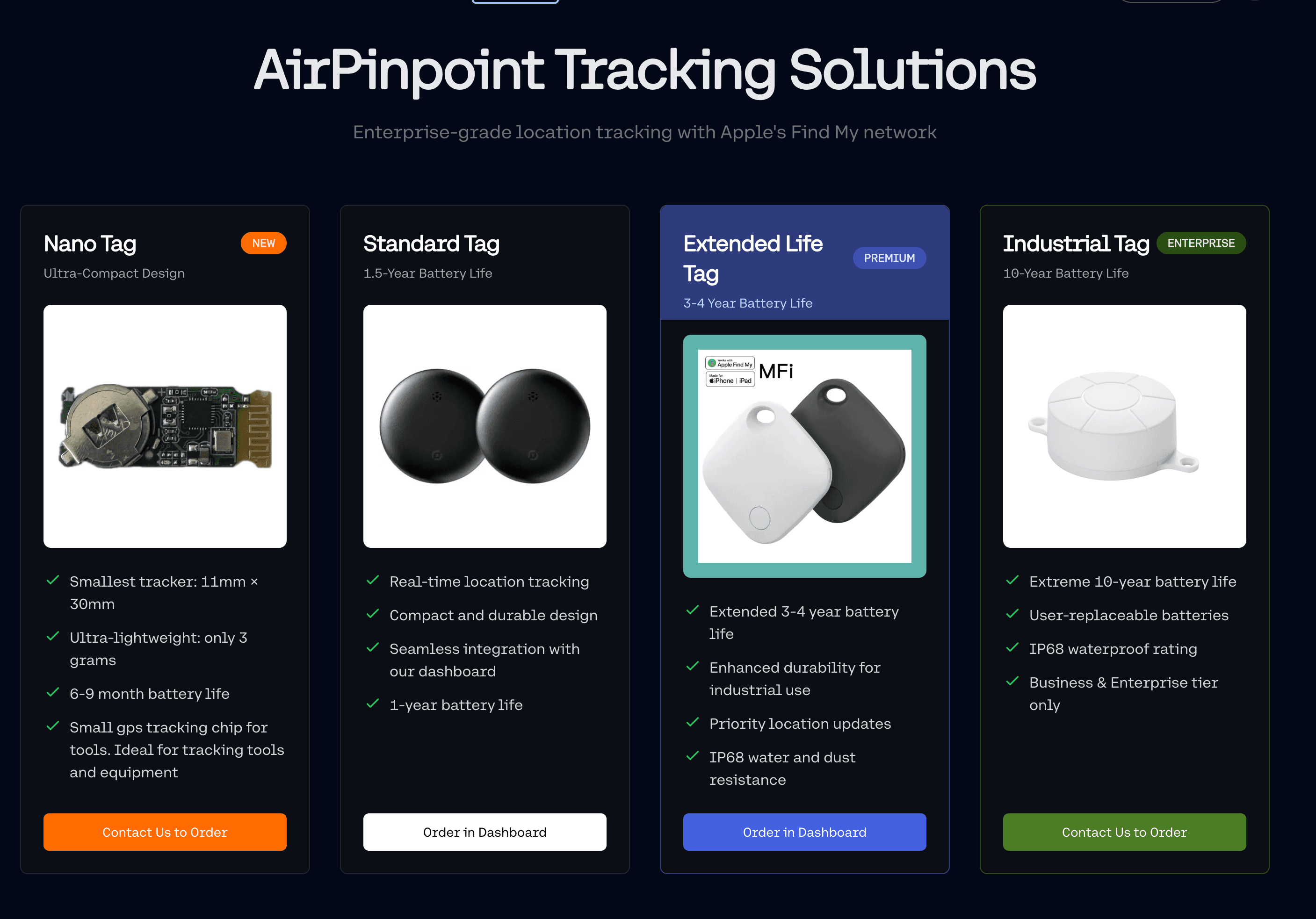
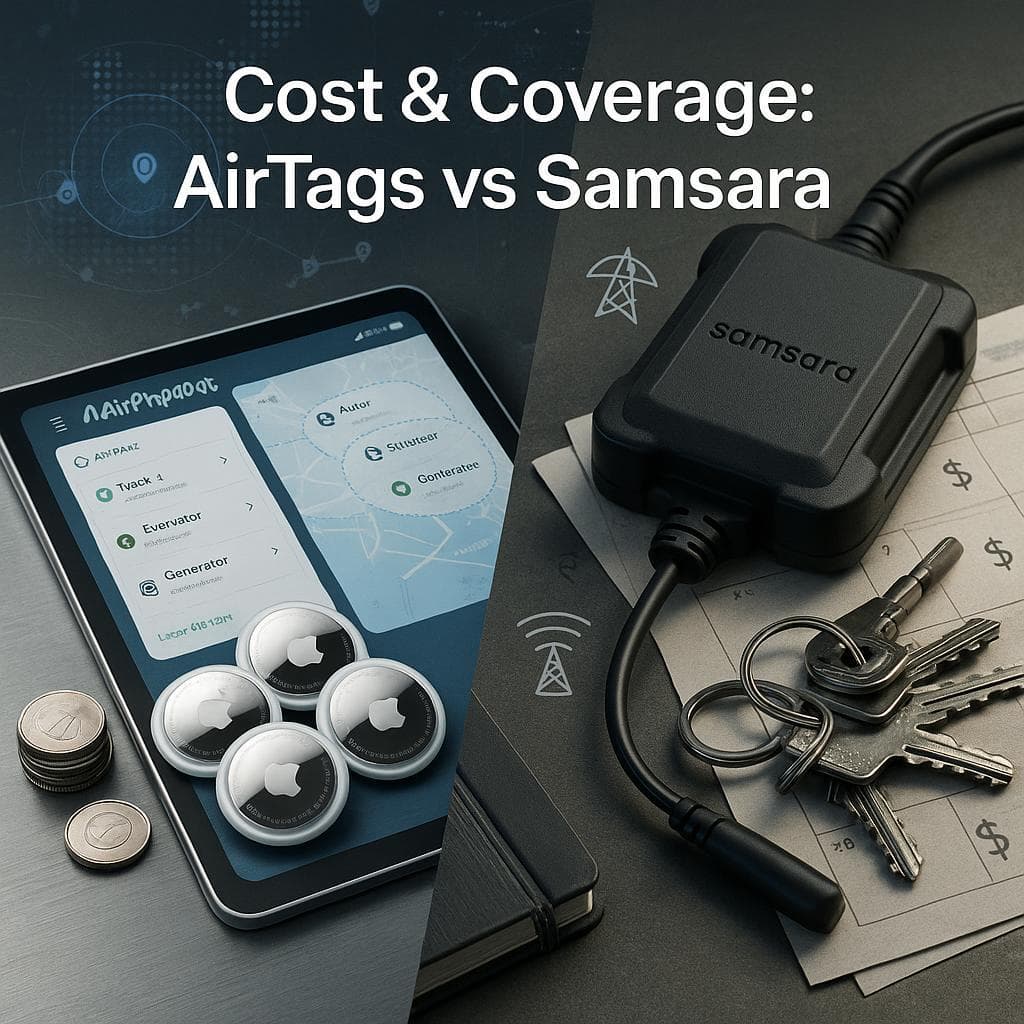
| AirTag | BLE location via Find My | $29 per tag |
Enterprise platforms like Samsara bundle hardware costs into the subscription or charge $99-148 per vehicle upfront. That hardware is proprietary. You can't take a Samsara OBD device and use it with Geotab.
Layer 2: Connectivity
Getting data from the vehicle to the cloud. This is the hidden cost driver.
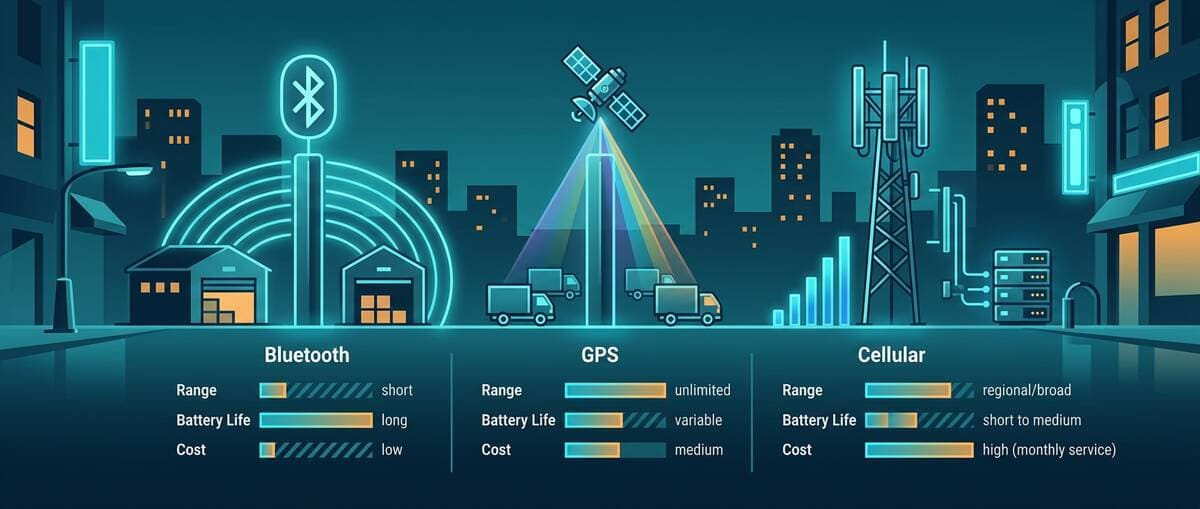
| Technology | Range | Monthly Cost | Latency | Power |
|---|---|---|---|---|
| Cellular (4G/5G) | Unlimited | $5-15/device | Seconds | High |
| Satellite | Global | $15-50/device | Minutes | High |
| LoRaWAN | 2-10 miles | $1-3/device | Seconds | Low |
| BLE mesh (Find My) | Global* | $0 | Minutes | Very low |
| WiFi | 150 feet | $0 (existing) | Seconds | Moderate |
*Find My coverage depends on Apple device density. Excellent in populated areas, limited in remote wilderness.
Cellular connectivity is the default for enterprise fleet management. Every GPS tracker and telematics device needs a SIM card and a data plan. This alone accounts for 30-40% of the monthly per-vehicle cost.
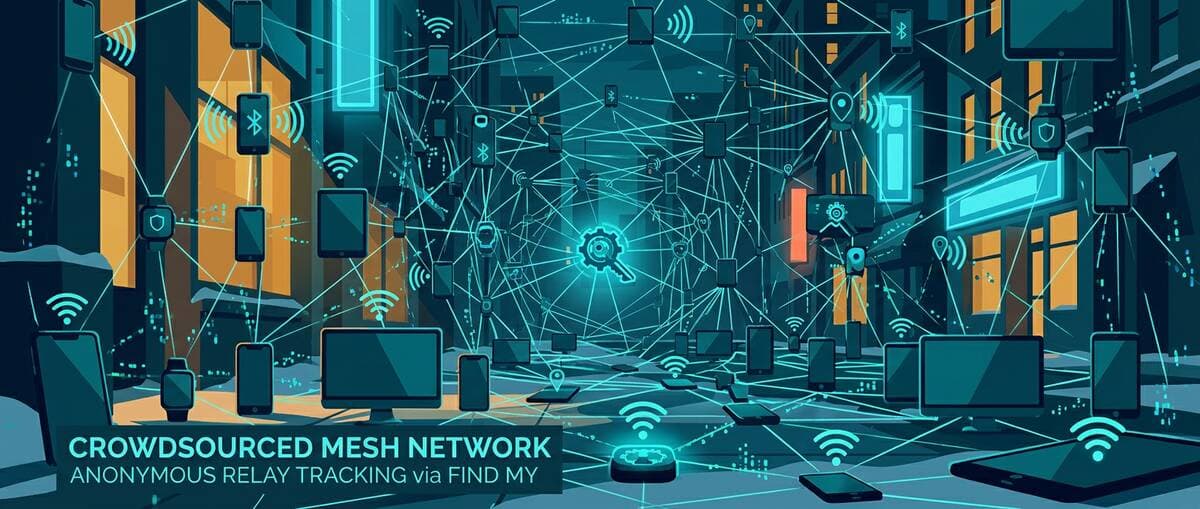
BLE mesh networks like Apple's Find My eliminate this layer entirely. The "connectivity" is over a billion iPhones, iPads, and Macs that relay encrypted Bluetooth signals for free.
Layer 3: Cloud Platform
Where data is stored, processed, and exposed via dashboards and APIs.
This layer handles:
- Data ingestion from thousands of devices simultaneously
- Normalization of different sensor formats into a unified schema
- Storage of location history, events, and telemetry
- API access for integrations with ERP, dispatch, and maintenance systems
- User management with role-based access
Platform costs are baked into the monthly per-vehicle subscription. Samsara, Geotab, and Teletrac Navman don't charge separately for cloud access. It's part of the $27-50/month.
Layer 4: Analytics and Alerts
The intelligence layer that turns raw data into decisions.
| Feature | What It Does | Who Needs It |
|---|---|---|
| Geofencing | Alert when vehicle enters/exits zones | Everyone |
| Driver scorecards | Rate braking, acceleration, speeding | Fleets with liability concerns |
| Fuel analytics | Track consumption, detect theft | High-fuel-cost fleets |
| Maintenance scheduling | Predict failures from engine data | Fleets with older vehicles |
| Route optimization | Reduce mileage and idle time | Delivery and service fleets |
| Compliance reporting | ELD, DVIR, HOS documentation | Regulated industries |
Most SMBs need two things from this list: geofencing and location history. They pay for all six.
What Enterprise IoT Fleet Management Actually Costs
Here's a realistic cost breakdown for a 50-vehicle fleet on a major platform.
| Cost Component | Per Vehicle/Month | 50-Vehicle Fleet/Month |
|---|---|---|
| Hardware (amortized over 3yr) | $3-5 | $150-250 |
| Cellular connectivity | $5-15 | $250-750 |
| Platform subscription | $15-30 | $750-1,500 |
| Installation labor | $2-4 (amortized) | $100-200 |
| Total | $25-54 | $1,250-2,700 |
Samsara's published pricing is $27-33 per vehicle per month, bundling hardware and connectivity into the subscription. But you're locked into a 3-year contract. That's $48,600-$59,400 for 50 vehicles over the contract term.
For context: the IoT fleet management market hit $9.17 billion in 2025 and is growing at 15.5% annually. It's projected to reach $17.35 billion by 2030. These numbers reflect real spending by real fleets, mostly on enterprise platforms that bundle everything together.
The Complexity Problem
Enterprise IoT fleet management works well for large fleets with dedicated fleet managers. It falls apart for everyone else.
Deployment takes weeks. Each vehicle needs hardware installed, wired to the OBD port or hardwired to the electrical system. Professional installation runs $50-150 per vehicle. Self-install is possible but voids some warranties.
Contracts lock you in. Samsara requires 3 years minimum. Geotab typically wants 2-3 years. Breaking early means paying the remaining balance.
Data overload is real. A single telematics device generates 25+ data points per second. Multiply by 50 vehicles and you're drowning in dashboards no one reads. Most fleet managers use less than 20% of the features they're paying for.
IT overhead compounds. Someone has to manage firmware updates, troubleshoot offline devices, handle SIM card activations, and deal with platform integrations. For a 10-vehicle operation, this overhead is absurd relative to the value.
The result: businesses with 5-50 vehicles either overpay for enterprise tools they barely use, or track nothing at all.
Apple Find My as an IoT Network
Apple's Find My network is, architecturally, an IoT mesh network. It just wasn't marketed that way.
The numbers:
- over a billion active Apple devices serve as relay nodes
- BLE signal broadcast range: 30-100 feet depending on environment
- End-to-end encrypted location reports
- Zero infrastructure cost per device
- Location updates every 1-15 minutes in populated areas
How it maps to the IoT stack:
| IoT Layer | Traditional Fleet | Find My Approach |
|---|---|---|
| Hardware | $99-200 OBD device | $29 AirTag |
| Connectivity | $5-15/mo cellular SIM | $0 (crowd-sourced BLE mesh) |
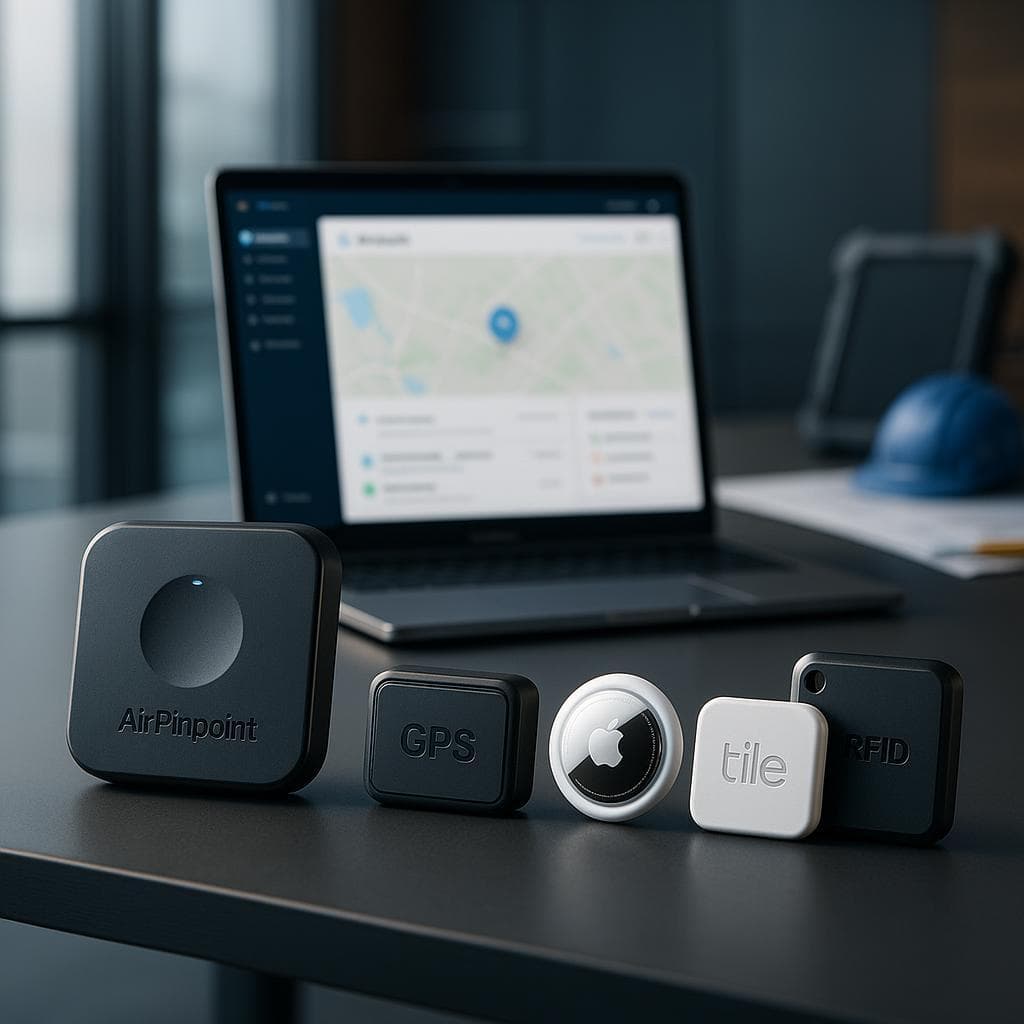
| Platform | $15-30/mo subscription | Airpinpoint from $2.40/tag/mo |
| Analytics | Included in subscription | Geofencing, history, alerts, API |
The trade-off is clear. You lose engine diagnostics, fuel monitoring, driver scorecards, and real-time second-by-second tracking. You gain 90% lower cost, zero installation, no contracts, and deployment in minutes.
For fleets that need location tracking (where are my vehicles, trailers, equipment, and tools right now?), this covers the core use case.
What Airpinpoint Adds to Find My
Apple's Find My app works for personal use. It doesn't work for fleet management. You can't share locations across a team, set geofences, export history, or integrate with other systems.
Airpinpoint turns Find My into a fleet management platform.
Fleet-grade features built on the Find My network:
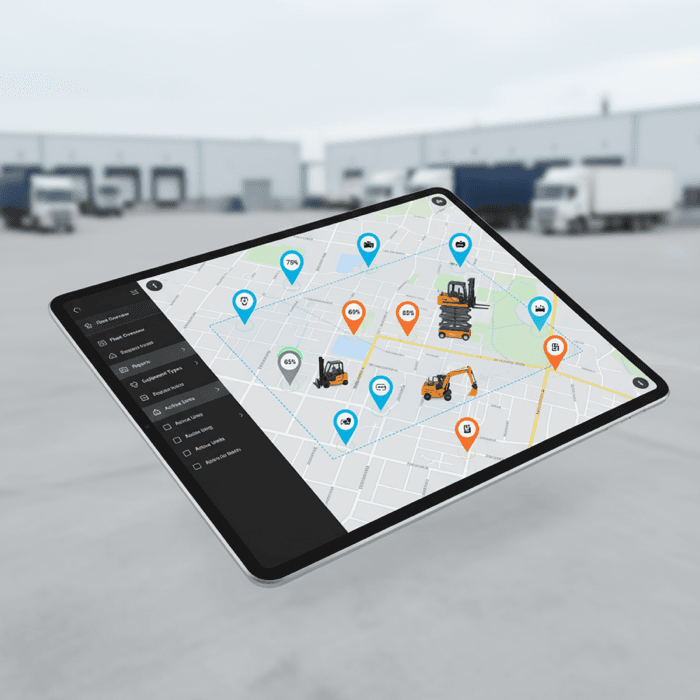
- Multi-user dashboard. Your whole team sees every tracked asset on one map. Role-based access controls who sees what.
- Geofence alerts. Draw polygons on the map. Get email alerts when assets enter or leave. Configurable thresholds prevent false alarms from GPS noise.
- Location history. Full movement history with playback. Export to CSV for compliance or billing.
- API and webhooks. Integrate location data with your dispatch, ERP, or maintenance systems. Real-time webhook notifications on geofence state changes.
- Bulk management. Add hundreds of tags at once. Organize by site, department, or asset type.
What it costs:
| Plan | Per Tag/Month | Features |
|---|---|---|
| Starter | $2.40 | Location tracking, history, team access |
| Pro | $4.00 | Geofencing, webhooks, API access |
| Enterprise | Custom | SSO, dedicated support, SLA |
No contracts. No hardware installation. No cellular plans. A 50-vehicle fleet on Airpinpoint Pro costs $200/month. The same fleet on Samsara costs $1,350-1,650/month.
When to Use IoT Fleet Management vs. Airpinpoint
This is not an either/or decision for every fleet. Here's when each approach makes sense.
Airpinpoint (Find My network) is right when:
- Location tracking is your primary need
- Assets operate in populated areas (cities, suburbs, towns)
- You're tracking trailers, equipment, tools, or containers
- Budget is a constraint (most SMBs)
- You need deployment in hours, not weeks
- You track assets that don't have OBD ports (trailers, generators, dumpsters)
Enterprise IoT platforms are right when:
- You need real-time engine diagnostics
- Regulatory compliance requires ELD/HOS logging
- Driver behavior scoring affects your insurance rates
- Assets operate in remote areas with no Apple device coverage
- Fuel optimization will save more than the platform costs
- You have a dedicated fleet manager to run the platform
Hybrid approach (common): GPS telematics on primary vehicles. AirTags on everything else. The math is what drives it: cellular telematics runs $25-45 per vehicle per month, so it is worth paying on a truck that needs engine data and driver behavior, and hard to justify on a trailer or a generator that only needs a location. Tags at $29 plus $11.99 per device per month cover the long tail of unpowered assets that would otherwise go untracked.
The IoT Fleet Management Stack Is Changing
The traditional model of proprietary hardware, cellular SIM cards, and $30+/vehicle/month subscriptions made sense when there was no alternative. Now there is.
Apple didn't build the Find My network for fleet management. They built it to find lost AirPods. But the technical architecture is identical to what enterprise IoT platforms spend millions deploying: a distributed sensor network with encrypted data relay to a cloud platform.
The difference: Apple's network has over a billion relay nodes, costs nothing to access, and the sensors cost $29.
For the 80% of fleet tracking that comes down to "where is this thing right now?", that's enough.
 Our Solution