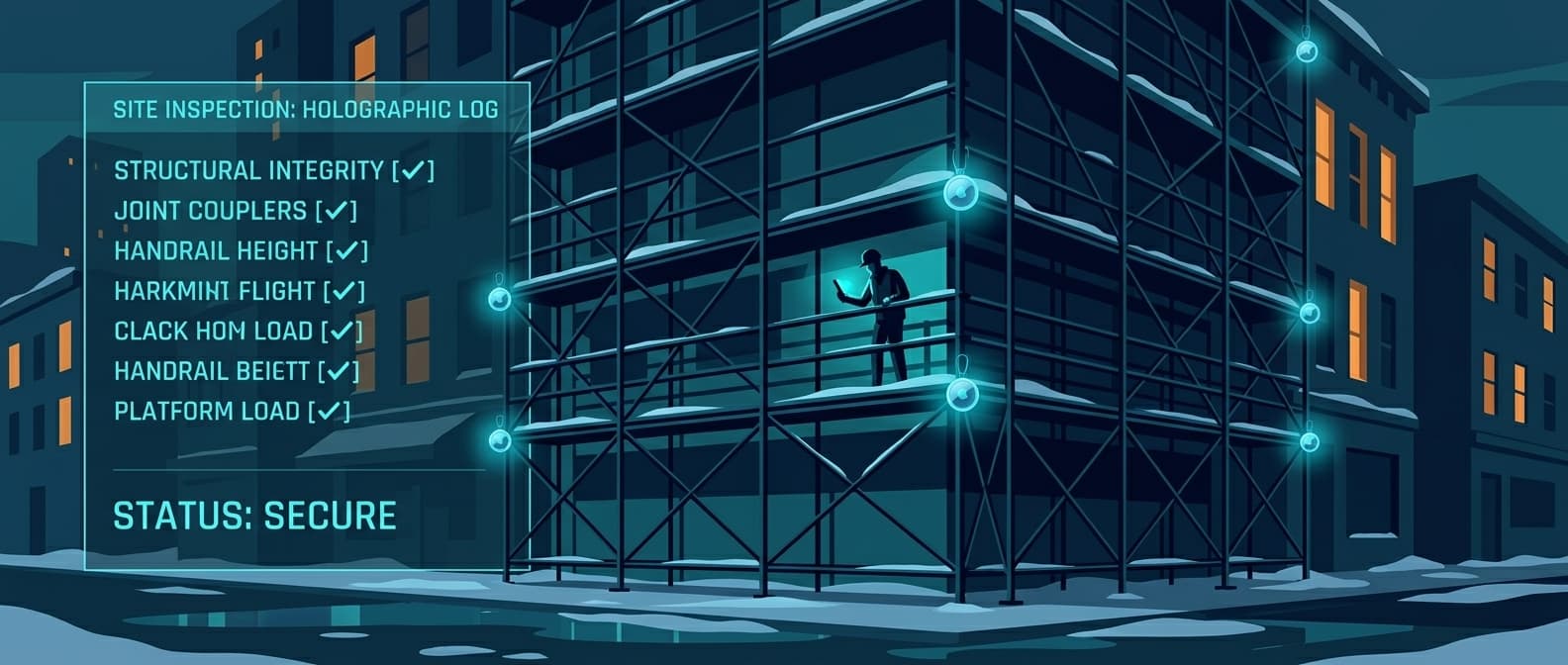
Scaffolding violations are the 7th most-cited OSHA standard, with 1,905 citations in fiscal year 2025. 4,500 workers are injured in scaffold-related incidents every year. 60 die. An inspection takes 10 minutes. Skipping it costs up to $16,550 per serious violation, or $165,514 if OSHA determines you were willful.
72% of scaffold accidents trace back to three causes: planking or support failure from defective equipment, slipping from lack of guardrails, and falling objects. All three are caught by a proper pre-shift inspection.
This post gives you three copy-paste checklists (scaffold, harness, ladder), the OSHA requirements behind each one, and a practical system for tracking which components have actually been inspected when they move between job sites.
Who Must Inspect, and When
OSHA 29 CFR 1926.451(f)(3) is specific: a competent person must inspect scaffolds and scaffold components for visible defects before each work shift and after any event that could affect structural integrity.
A competent person is not just any supervisor. OSHA defines it as someone who can identify existing and predictable hazards, has specific training in scaffold structural integrity, and has the authority to take immediate corrective action. That last part matters. If your inspector can flag a problem but can't stop work, they don't meet the definition.
For fall protection equipment (harnesses, lanyards, SRLs), OSHA requires a competent person inspection at least annually, plus a visual inspection by the user before each use.
For ladders, 29 CFR 1926.1053 requires inspection by a competent person for visible defects on a periodic basis and after any occurrence that could affect safe use.
Scaffold Inspection Checklist (Pre-Shift)
Run this before every shift. Takes 10 minutes for a standard scaffold setup. Any single failure is a stop-work item until corrected.
Foundation and Base
- Base plates are in firm contact with the ground or supporting surface
- Mud sills (sole boards) are present on soft or uneven ground
- Base plates are centered on mud sills, not overhanging edges
- Screw jacks (if used) are no more than 12 inches above the base plate
- The scaffold is plumb and level
- No evidence of ground settlement, erosion, or undermining
Structure and Framing
- All cross braces are in place and secured at connection points
- Frames are properly aligned and locked together
- Coupling pins are fully inserted and secured
- No bent, cracked, or corroded frame members
- Scaffold is tied to the building at required intervals (every 26 feet vertically, 30 feet horizontally for frame scaffolds)
- Scaffold does not lean away from the structure
Platforms and Planking
- Platforms are fully planked between front uprights and guardrail supports
- No gaps greater than 1 inch between planks (except where wider for fitment, max 9.5 inches)
- Platform planks extend at least 6 inches beyond support, but no more than 12 inches (unless cleated or restrained)
- Planks are not cracked, split, or warped
- Platforms are at least 18 inches wide
- No scaffold plank is loaded beyond its rated capacity
Guardrails and Fall Protection
- Top rail is installed at 38 to 45 inches above the platform
- Mid rail is installed approximately halfway between the top rail and platform
- Toe boards (at least 3.5 inches tall) are installed on all open sides
- All guardrail components are secure and free of defects
- Cross braces used as guardrails meet height requirements (between 38 and 48 inches for the top, between 20 and 30 inches for the mid)
Access
- Ladder, stair tower, or ramp access is provided for scaffold platforms more than 2 feet above the ground
- Access ladders extend at least 3 feet above the platform landing
- No climbing on cross braces as a means of access
- Access points are not blocked by materials or equipment
Electrical and Overhead Hazards
- Scaffold is at least 10 feet from energized power lines (under 50kV)
- No overhead hazards (falling objects, crane swing radius)
- Scaffold components are not in contact with electrical wiring
Load and Capacity
- Load rating is posted on the scaffold
- Current load (workers, materials, tools) does not exceed rated capacity
- No accumulation of debris, ice, or standing water on platforms
Harness Inspection Checklist (Pre-Use)
Every worker should run this before clipping in. Takes 3 minutes. Any defect means the harness is removed from service immediately.
Webbing
- No cuts, tears, or fraying on any strap
- Bend webbing in a U-shape and inspect both sides for broken fibers (damage hides on the inner surface)
- No hard or shiny spots (indicates heat or chemical damage)
- No discoloration from UV exposure or chemical contact
- No paint, solvents, or contaminants embedded in the webbing
- Webbing is not stretched or thinned in any area
Stitching
- All stitch patterns are intact, no pulled, cut, or missing stitches
- Thread is not hard, shiny, or discolored (signs of heat damage)
- No loose threads at buckle or D-ring attachment points
- Stitching at load-bearing points (dorsal D-ring, leg straps) is complete
D-Rings and Hardware
- Dorsal D-ring is free of cracks, bends, or deformation
- All D-rings pivot freely and are not corroded
- Buckles (tongue, pass-through, or quick-connect) latch and release properly
- No sharp edges on any metal component
- Grommets (if present) are not pulled through or loose
- Snap hooks are self-closing and self-locking (gate locks without manual hold)
Labels and Documentation
- Manufacturer's label is legible with model number, date of manufacture, and load rating
- Harness has not exceeded the manufacturer's recommended service life (typically 5 years from first use or 7 from manufacture)
- Annual competent person inspection is current (within the last 12 months)
- Harness has not been involved in a fall arrest event (if it has, remove from service)
Fit Check
- Chest strap is snug at mid-chest level
- Leg straps are snug but allow two fingers between strap and leg
- Dorsal D-ring sits between the shoulder blades
- No twisted straps
- Sub-pelvic strap (if present) is connected and adjusted
Ladder Inspection Checklist
OSHA 1926.1053 requires periodic inspection plus inspection after any event that could affect safe use. Any defect: tag it "Do Not Use" and pull it from service.
Structural Components
- Rails are straight, not bent, cracked, split, or corroded
- All rungs and steps are present (no missing rungs)
- Rungs are tight in the rails, no looseness or rotation
- No broken or damaged rung locks on extension ladders
- Spreader bars on stepladders lock fully open
- Rope and pulley on extension ladders function properly
Hardware and Feet
- All bolts, rivets, and fasteners are tight
- Safety feet (rubber pads) are present and not worn smooth
- No makeshift repairs (tape, wire, splints)
- Duty rating label is legible and appropriate for intended load
Condition
- Free of oil, grease, mud, or other slipping hazards
- Fiberglass ladders: no cracks, chips, or exposed fiberglass (indicates UV degradation)
- Aluminum ladders: no dents or corrosion at stress points
- Wood ladders: no rot, cracks, or missing protective coating
Setup (Before Each Use)
- Placed on stable, level surface
- 4-to-1 rule applied (base 1 foot out for every 4 feet of height)
- Top of ladder extends at least 3 feet above the landing surface
- Secured at the top, bottom, or both to prevent displacement
- Not placed in front of doors that could open into the ladder (unless door is locked or guarded)
The Tracking Problem: Inspections Break Down When Equipment Moves
These checklists work on paper. The breakdown happens in practice, specifically when scaffold components move between job sites.
A scaffolding company running 15 active job sites has thousands of components in circulation. Scaffold sections get pulled from Site A to fill a shortage at Site B. Harnesses move between crews. Extension ladders ride around in trucks for weeks.
The inspection question shifts from "did we inspect this?" to "where is this, and when was it last inspected?"
Paper logs stay at the job site. The component doesn't. By the time section #47 shows up at a new site, nobody knows if it was inspected last week or last month.
What Falls Through the Cracks
Scaffold sections transferred between sites. A foreman pulls 20 frames from a completed job and sends them to a new site. The inspection log at the old site shows them as current. The new site has no record of them. They go up without an inspection.
Harnesses that follow workers, not sites. A worker takes their harness to three different sites in a week. Each site assumes the harness was inspected at the previous one. Nobody checks.
Ladders in fleet vehicles. Extension ladders live in trucks. They're technically assigned to a site when the truck shows up, but they never appear on a site inventory until something goes wrong.
A Digital System That Travels With the Equipment
The fix is attaching the inspection status to the physical equipment, not the job site. When you track scaffold components with AirTags and Airpinpoint, each component's location is recorded continuously through Apple's Find My network.
This means:
You know where every scaffold section is right now. Not where the spreadsheet says it should be. Where it actually is. When section #47 moves from Site A to Site B, you see it in the dashboard before the site super calls to report it.
You can flag components due for inspection. If a scaffold cage hasn't been logged as inspected in the last 24 hours and it's at an active job site, it shows up on the exception report. No component goes uninspected because it moved between sites overnight.
Geofence alerts catch unauthorized transfers. When scaffold sections leave a job site perimeter, Airpinpoint sends an alert. This catches both theft and the undocumented inter-site transfers that break your inspection chain.
You have a location-stamped compliance trail. If OSHA asks when a specific scaffold section arrived at a site and whether it was inspected before use, you have timestamped location data instead of a foreman's memory.
For the full breakdown on tracking scaffolding components across job sites, read Scaffolding Management Software: Track Components Across Every Job Site.
Inspection Frequency Summary
| Equipment | Standard | Who Inspects | Frequency |
|---|---|---|---|
| Scaffolds | 29 CFR 1926.451(f)(3) | Competent person | Before each work shift + after any damage event |
| Scaffold ropes | 29 CFR 1926.451(f)(3) | Competent person | Before each work shift + after any damage event |
| Fall protection harnesses | 29 CFR 1926.502(d) | User + competent person | User: before each use. Competent person: at least annually |
| Lanyards and SRLs | 29 CFR 1926.502(d) | User + competent person | User: before each use. Competent person: at least annually |
| Ladders | 29 CFR 1926.1053(b)(15) | Competent person | Periodic + after any damage event |
What Happens When You Fail an Inspection
Stop-work is not optional. OSHA 1926.451(f)(3) is clear: if a competent person identifies a defect, the scaffold or component must be removed from service until repaired.
For harnesses, the standard is even stricter. A harness that has arrested a fall is permanently retired. No repairs, no re-certification. Same for any harness with cut webbing, cracked D-rings, or damaged stitching.
For ladders, any structural defect means the ladder gets tagged "Do Not Use" and removed from the work area. Do not lean it against a wall with a note. Remove it physically or someone will use it.
The cost of pulling a defective component from service is zero. The cost of not pulling it: $16,550 per serious violation, plus the incalculable cost if someone gets hurt.
Start Tracking Scaffold Equipment Across Sites
If you're managing scaffold components across multiple job sites and losing track of what's where, Airpinpoint gives you real-time location tracking for every scaffold cage, pallet, and bin. Attach an AirTag, and you'll know exactly which site has your equipment, when it arrived, and whether it's due for inspection.
Start your free trial or read more about scaffolding tracking with Airpinpoint.
Apple stops at 32 AirTags per account
Airpinpoint tracks unlimited tags in one dashboard, with location updates about every 5 minutes, geofence alerts, and a REST API, from $11.99 per tag per month.
Free to start. Works with the AirTags you already own. 6,700+ tags under management.
